自然保护与休闲部
保护·守护·共享
自然保护与休闲部


Understanding flood risk requires knowing which areas of your community are exposed to flooding today, and which areas are expected to be exposed in the coming decades. Due to changing patterns of precipitation, sea level rise, and development, historic flooding trends are no longer a useful predictor of future risk.
Nationwide, we lack consistent, locally specific data that forecasts flooding based on multiple risk sources. The Commonwealth is closing these data gaps and providing data tools to support flood resilience planning efforts in Virginia.
DCR provides two non-regulatory flood hazard datasets that can be used together with regulatory data to support more informed flood resilience planning: a coastal Virginia flood hazard dataset (developed for the Coastal Resilience Master Plan) and a statewide Fathom flood hazard dataset (procured for the Virginia Flood Protection Master Plan). The table below explores and compares these two resources. In addition, DCR provides flood impact data for coastal Virginia to explore how assets may be affected by flood conditions. Users can access and explore this resource via the Coastal Resilience Web Explorer.
|
Coastal Virginia Flood Hazard Data |
Fathom Flood Hazard Data |
Geographic Area |
Coastal: localities within any of the eight easternmost Planning District Commissions in Virginia. |
Statewide: The entire Commonwealth of Virginia. |
Flood Hazards |
Coastal, riverine, and rainfall-driven flooding |
Coastal, riverine, and rainfall-driven flooding |
Recurrence Intervals |
Seven recurrence intervals: 1 in 2-, 5-, 10-, 25-, 50-, 100-, and 500-year. Three tidal conditions (MLW, MHW, 1.5xMTR) are also available for coastal flood data. |
Five recurrence intervals*: 1 in 10-, 25-, 50-, 100- and 500-year. |
Associated DCR Plan |
Coastal Resilience Master Plan (CRMP) |
Virginia Flood Protection Master Plan (VFPMP) |
Planning Scenarios |
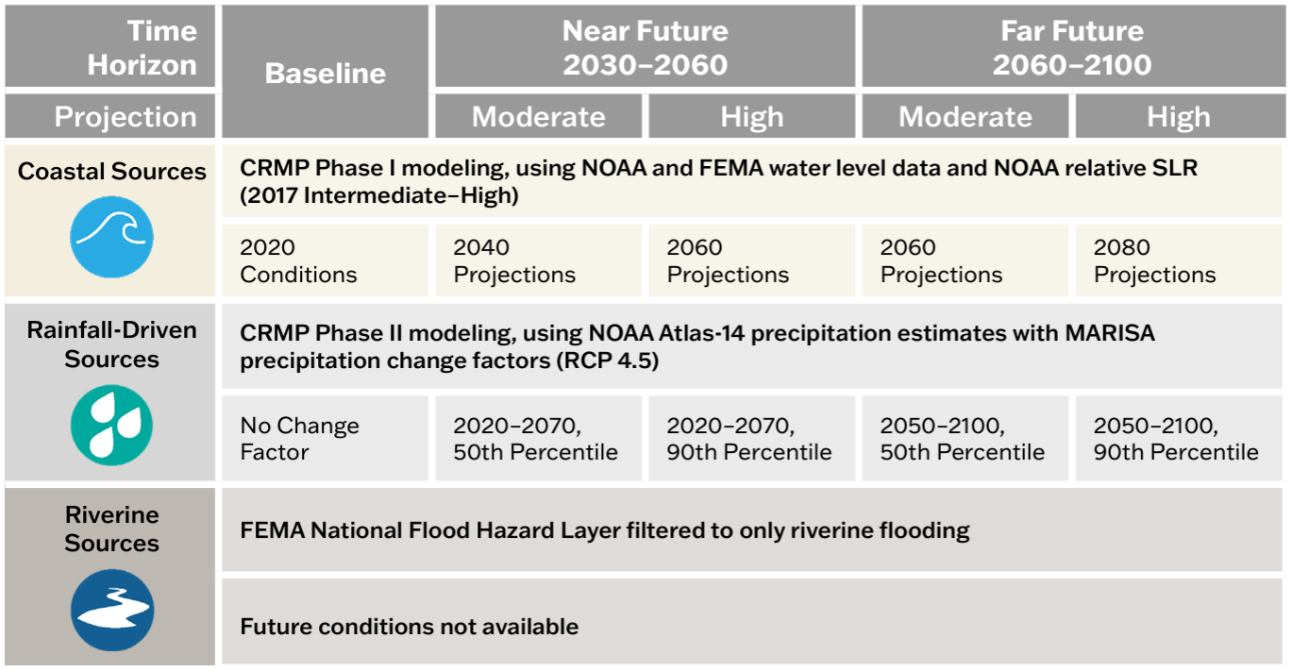
Five planning scenarios: baseline (2020), plus “moderate” and “high” scenario options for the near future (2030-2060) and far future (2060-2100) time horizons. |
Five planning scenarios: baseline (2020), plus two “moderate” and “higher” scenario options for the 2060- and 2100-time horizons. |
Basis for Future Conditions |
Varies by flood source and planning scenario. See reference figure for more information. |
Shared Socioeconomic Pathway 2-4.5 (SSP2-4.5). “Moderate” scenario based on median (50th percentile) values and “higher” scenario based on 83rd percentile values. |
决议 |
10-foot |
10-meter (~33-foot) |
來源 |
DCR with underlying data from the United States Army Corps of Engineers, the National Oceanic and Atmospheric Administration, and the Federal Emergency Management Agency. |
Fathom |
訪問 |
View and download data and methodology documentation via DCR’s Flood Resilience Open Data Portal. |
View the 1 in 100- and 500-year data for baseline conditions via DCR’s Flood Resilience Open Data Portal. Access to all other products is provided to VA public institutions.* |
其他信息 |
Learn more via the overview one-pager. Learn more about Flood Hazard Data Development in Appendix A of the CRMP Phase II. Learn more about the asset data and impact assessment methodology in Appendix B of the CRMP Phase II |
Learn more via the overview one-pager. |
*Virginia government entities and state-recognized Tribal governments may sub-license all Fathom data from DCR for a 12-month renewable license term. To inquire about a sub-license agreement, including data use limitations, please contact us at flood.resilience@dcr.virginia.gov.
Additional data to visualize and understand flood hazards is available through state and federal platforms. Below is a snapshot of these data resources which can be accessed through the links provided.
There are many tools to aid organizations in crafting a flood resilience plan. Below is an abbreviated list of useful planning tools. Additional tools can be found on the information gateways linked below.
The following tools were developed with Virginia-specific needs in mind. While some are focused on exploring flood resilience specifically, others support resilience planning more broadly.
Federal agencies have developed tools to assist organizations to plan and implement successful flood resilience strategies. The following resources may help you to craft your resilience plan.
These portals and databases contain a variety of resources – such as data, planning tools and funding information – that may be useful to your organization as you develop your resilience plan:
Organizations developing flood resilience plans should consider approaches which align both with DCR’s flood resilience plan guidance, as well as with federal resources and funding opportunities. Resources to help you understand how to align your approach to resilience planning with available funding resources include:
DCR administers the Community Flood Preparedness Fund (CFPF) and the Resilient Virginia Revolving Fund (RVRF). For more information on these funds visit the DCR Floodplain Management, Flood Resilience Funding website.
Beyond the DCR administered resilience funds, the Coastal Resilience Web Explorer Funding Opportunities tab provides an inventory of funding sources that may be available to finance the development and/or implementation of your plan. While it is catered to the coastal region, non-coastal activities may be eligible for some listed opportunities.
The DCR Flood Resilience Funding Geographic Focal Area Viewer identifies geographic areas that are designated as either required or preferred for resilience funding, including Low-Income Geographic Areas for the DCR Community Flood Preparedness Fund.
与弗吉尼亚州防洪规划相关的历史报告可通过下面的下拉菜单存档。
在 2024 大会会议期间,众议院议案 1458 修改了《Virginia法典》中的抗洪状况报告的要求(§ 2.2-220。5)包括 Commonwealth 的整体抗灾能力,包括抗洪能力。该报告于7月 2025 发布,此后每两年发布一次,包括首席抗灾官和州机构在抗灾能力协调和规划方面采取的行动状况,以及Commonwealth在过去两年中收到和分配的所有抗灾资金。
在 2024 大会会议期间,众议院议案 1458 修改了《Virginia法典》中的抗洪状况报告的要求(§ 2.2-220。5)包括 Commonwealth 的整体抗灾能力,包括抗洪能力。该报告于7月 2025 发布,此后每两年发布一次,包括首席抗灾官和州机构在抗灾能力协调和规划方面采取的行动状况,以及Commonwealth在过去两年中收到和分配的所有抗灾资金。
弗吉尼亚联邦大学 (VCU) 公共政策中心 (CPP) 在联邦洪水灾害恢复力中心 (CCRFR) 的资金支持下,为 RCWG 提供了便利。
2023 ,弗吉尼亚州首席防洪官根据《弗吉尼亚州法典》(§ 2 . 2 - 220 . 5 )的规定,向州长和州议会发布了一份关于弗吉尼亚州防洪状况的两年期报告。
阅读2023 《抗洪现状报告》。